
When deciding to actually go on a cross-country road trip, there are so many questions you have to answer and so many decisions to make. Where do you want to go? How much time do you want to spend in each place? How much driving are you ok doing in one day? Are you going to camp? How are you planning to feed yourself? How do you pack for this? When we started planning this out, I truly did not anticipate how strategic you need to be, but I do believe we did pretty well! While I will be diving into some logistics, this post is more specifically on how to plan out your route. So check back for other future posts to go more in-depth on each location specifically.
To start with, I also want to mention that our trip itinerary was longer than most and took three weeks to complete. So whether you are planning a trip like this or one half its size, check out our itinerary and tips below!
Our Road Trip Itinerary
Start: Central Ohio
St. Louis Gateway Arch, MO - Quick stop
Carlsbad Caverns, NM
White Sands National Park, NM
Saguaro National Park, AZ
Joshua Tree National Park, CA
Horseshoe Bend, AZ - Quick stop
Antelope Canyon, AZ - Quick stop
Grand Canyon National Park, AZ
Mesa Verde, CO
Arches National Park, UT
Dinosaur National Monument, UT - Quick stop
Grand Teton National Park, WY
Yellowstone National Park, WY
Mount Rushmore, SD - Quick stop
Badlands National Park, SD - Quick stop
Choosing Your Route
This is what I would consider the most daunting part of the entire planning process. When it comes to planning your route, if you're like me, you're overthinking to ensure that you are maximizing all of your options. While getting online is necessary and finding articles like this is helpful, what I recommend is starting with a map and putting a pin on ALL of the places you want to go. Let what you want to do dictate your route. Don’t paint yourself into a box when your dream is to be a star. That said, we used the App Wonderlog. Wonderlog is a travel planning app where you pin the places you want to go, add transportation information, and manage trip logistics. This made it really easy for us to go in and add all of the National Parks we wanted to visit. As a visual learner, being able to see where each location was on a map was a game-changer. Once all the parks we wanted to visit were charted on the map, we were able to assess which ones provided a natural progression to California and back.
1. Consider the Weather
The specific focus of our trip was to hop from National Park to National Park, so the weather was a large factor to consider. For example, we were going right at the beginning of June, which meant that we needed to start south to hit the desert parks before it got unbearably hot. This is not simply because of comfort; it is also about safety. To quote Joshua Tree National Park, “Do Not Die Today”. When you are going to the desert during the summer months, everything is trying to kill you, literally. The sun is trying to fry your skin off, and the heat is dehydrating every bit of water in your body. So while the summer months are less crowded, they do come with challenges. Had we been even a few days later on our journey, the heat in places like Saguaro would have been dangerous enough to prevent us from doing any hiking in the park at all.
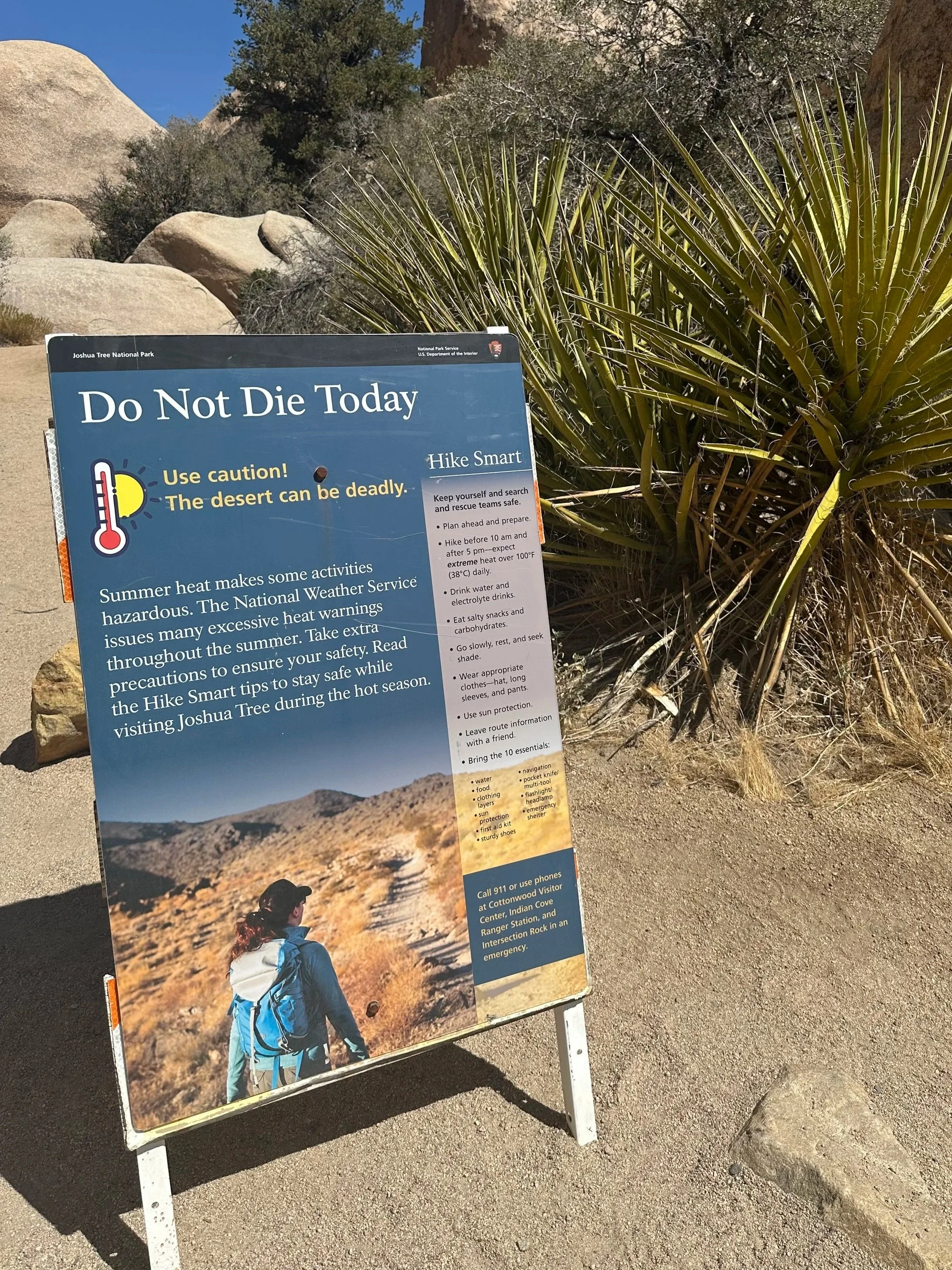
This not only holds true for the desert but for any extreme weather conditions you may encounter, and trust me, you will encounter them all on a trip like this. On our specific trip, we were well prepared for the desert, but not much for temperatures under 40 degrees with snow. Although, as long as you have enough layers to put on and a gift shop where you can buy a really nice beanie, you should be just fine.
2. Consider Your Transportation and Lodging
A trip like this is nothing without a solid plan for transportation and lodging, and how you choose to sleep will have a big impact on how much time it takes you to complete your trip. Additionally, it will also have a large impact on what you can do and experience. For example, trailers/campers may not be permitted in certain parks, which means you may be out of luck if that is your only mode of transportation or if you can’t unhitch. This is something we encountered at Mesa Verde National Park. Lucky for us, my husband had become an expert at hitching us up! That said, you will want to ensure that you know the rules of the parks you are trying to visit so that you do not get caught off guard. We chose to take our Volvo SUV with a rented tow-behind teardrop trailer for our adventure.
When it comes to eating and sleeping, the location that you choose to stay can also make or break your experience, and that is why I highly recommend camping within the parks themselves. Staying within the parks opens up a whole new host of experiences after the parks close that you may not otherwise be able to access after dark. For example, had we not stayed within Mesa Verde, we would not have been able to take advantage of the dark sky park and stargaze into the Milky Way for hours or wake up next to the most beautiful sunrise between giant saguaros in Arizona. Another benefit to camping in the park is that you are supporting the very place you are visiting. Do you love to see a well-kept path or attend ranger programs? Sales from campsite reservations help to directly fund such park operations.
3. Consider Personal Hygiene Preferences
While I love getting out and appreciating nature, I will avoid porta-potties like the plague. And yes, while composting toilets really aren’t so bad, I certainly still prefer a porcelain experience. That said, when choosing a campsite, running water was my top priority, and I am happy to report we were able to find that at most sites. That said, some of the coolest places we stayed at did not have running water, and I did in fact survive. This is a great reminder that discomfort can often lead to unforgettable experiences, and sometimes it’s good to push yourself.
But bringing it back, showers may not always be available, even if the park has running water. So my suggestion is to plan a route with shower access every couple of days, and if you find an unexpected shower, thank the National Park gods!
4. Purposefully Build in Time to be Flexible
This is probably one of the most important points to stress: you need to approach this trip with a flexible mindset, especially if you are traveling with another human. If you know me (and saw my wedding day binder), you know that I am a planner to the tenth power. And in no surprise to anyone, I can really struggle if my plan for the day has to change. To help me be more flexible, I will literally plan for flexibility. Now I know it sounds kind of silly, but if I can plan ahead and factor in time to be flexible, I will usually always have a better time. I think it’s also important to note that this mindset should also be practiced with your traveling partner as well. You may have different ideas on what you want to experience, or you may have differences in physical ability. The latter came into play for us quite a bit, and I am very grateful for my husband who practices a lot of patience and flexibility when it comes to my physical limitations.
5. Pre-establish What is Most Important for You
One of the most important things for me was planning a route that served both of our wants and needs, and part of that comes from communicating clearly what your wants and needs are for the trip. By being transparent ahead of time (and revisiting this conversation multiple times throughout), you can make adjustments that speak to what each traveler wants. I mean, think about it, if you aren’t aware of what is important to your partner, how are you going to execute a trip that is equally fulfilling? If you are only making changes or considering one outlook, it is likely that one of you will get frustrated or tired, and that will make a long trip like this miserable. So, I recommend that before you solidify your route, you have an honest conversation about your vision and talk about what the most important pieces of this experience are for you.
While this certainly isn’t the only way to plan a road trip, taking all of these things into consideration really helped us plan an unforgettable adventure. So it is my hope that after reading this, you are inspired to take the leap and plan your own!
